
Most small businesses in Marquette face cybersecurity risks that can disrupt daily operations, expose customer information, and create expensive recovery challenges. From phishing emails and stolen passwords to ransomware and outdated software, even a small security weakness can affect an entire business.
Whether you operate a retail store, healthcare practice, restaurant, construction company, or professional office in Michigan’s Upper Peninsula, having a practical cybersecurity plan is essential.
The good news? Improving cybersecurity does not always require expensive enterprise software. Many important protections begin with basic security practices, employee awareness, and regular system maintenance.
This small business cybersecurity checklist covers 11 essential steps to help Marquette business owners protect their networks, accounts, devices, and sensitive data.
What Should Be on a Small Business Cybersecurity Checklist?
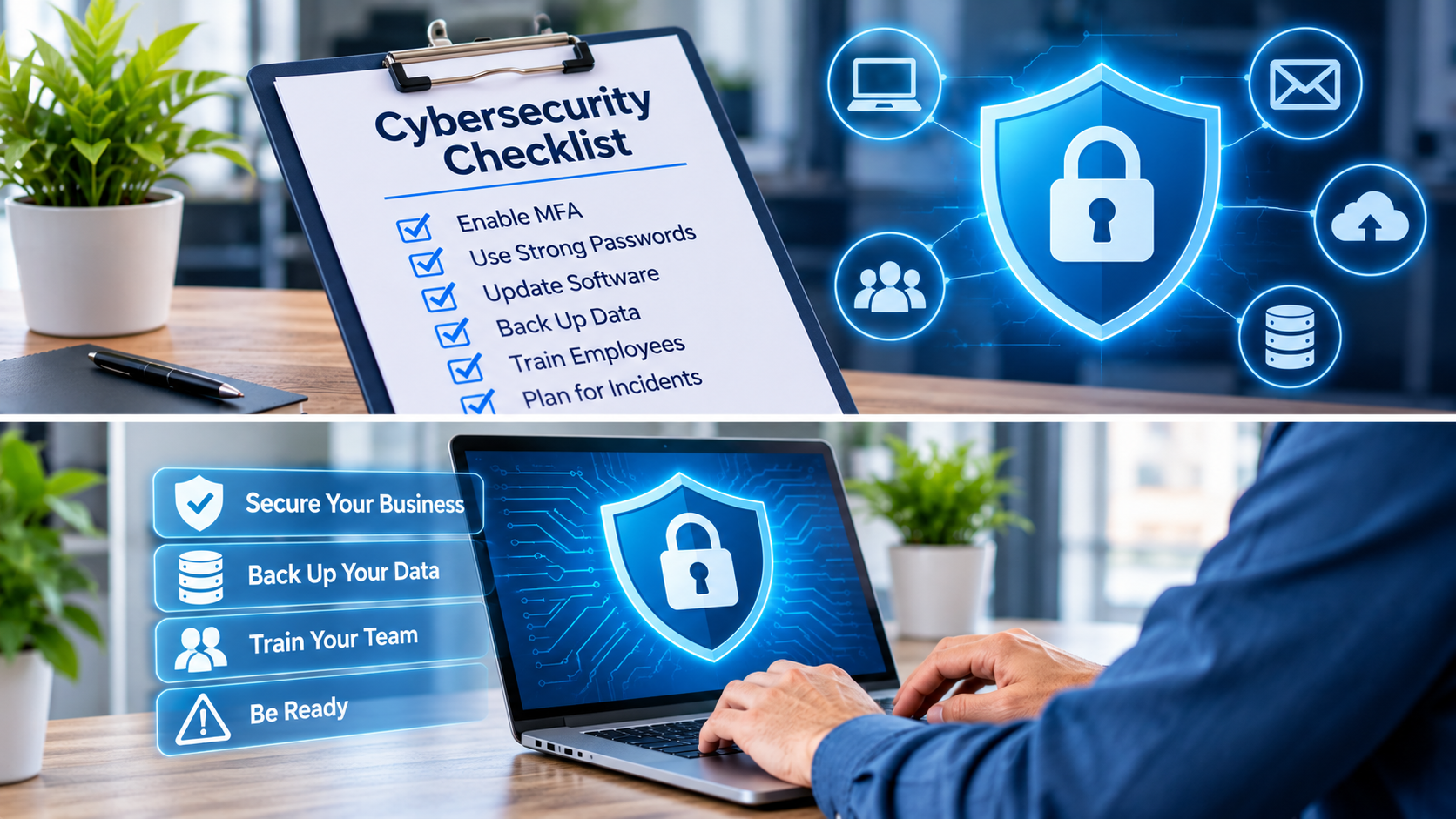
A small business cybersecurity checklist should include multi-factor authentication (MFA), strong passwords, an inventory of devices and accounts, software updates, secure Wi-Fi, email protection, access controls, tested data backups, employee training, vendor security reviews, and an incident response plan.
These 11 cybersecurity practices help small businesses reduce common security risks and prepare for potential incidents.
For businesses in Marquette, MI, and the Upper Peninsula, combining these practices with reliable IT support can help maintain stronger, more consistent security.
Quick cybersecurity priorities:
- Protect accounts: Enable MFA and use unique passwords.
- Secure devices: Keep software updated and maintain an inventory.
- Protect business networks: Configure firewalls, Wi-Fi, and remote access securely.
- Protect important data: Maintain backups and regularly test recovery.
- Prepare employees: Provide phishing awareness training.
- Plan for incidents: Establish clear reporting and recovery procedures.
The following checklist explains how to implement these protections.
1. Create an Inventory of Business Devices and Accounts
Why it matters: You cannot effectively protect technology you do not know exists.
Begin by documenting the hardware, software, and online accounts used throughout your business.
Your inventory should include:
- Desktop computers and laptops.
- Business smartphones and tablets.
- Servers, routers, and firewalls.
- Printers and network-connected devices.
- Security cameras and VoIP phone systems.
- Business email accounts and cloud applications.
- Accounting, payment, and scheduling software.
- Administrative accounts and third-party access.
Record who owns or manages each system, its purpose, and when it was last reviewed.
For small businesses with limited IT resources, maintaining this information helps reduce overlooked security risks and simplifies troubleshooting.
Businesses that need ongoing device management can explore IT and Managed Services in Marquette County to learn about Superior Eagle’s technology support options.
Action item: Create a centralized asset inventory and update it whenever employees, devices, or applications change.
2. Use Strong Passwords and a Password Manager
Weak or reused passwords can allow attackers to access multiple business accounts after a single credential is compromised.
Every employee should use unique login credentials for business systems.
Password security checklist:
- Use long, unique passwords or passphrases.
- Avoid reusing passwords across business accounts.
- Use a reputable password manager.
- Replace manufacturer-default passwords.
- Limit shared accounts wherever possible.
- Disable unnecessary accounts when employees or vendors leave.
A password manager helps employees create and securely store unique credentials without memorizing every password.
Action item: Prioritize business email, financial accounts, administrative systems, and cloud applications.
3. Enable Multi-Factor Authentication (MFA)
Multi-factor authentication is one of the most important cybersecurity protections for small businesses.
MFA requires an additional verification method beyond a password, making unauthorized access more difficult even when login credentials are stolen.
Enable MFA for:
- Business email accounts.
- Banking and payment platforms.
- Cloud storage and business applications.
- Remote access systems.
- Administrative accounts.
- Accounting and payroll software.
Where available, choose phishing-resistant authentication methods, such as passkeys or FIDO2 security keys. Authenticator apps are generally preferable to SMS codes when stronger options are not supported.
Action item: Enable MFA on critical accounts immediately rather than waiting until later in a security improvement project.
4. Keep Software Updated and Review Firewall Security
Outdated software and network equipment can contain vulnerabilities that attackers exploit.
A small business network security checklist should include regular updates for:
- Operating systems.
- Web browsers.
- Business applications.
- Network firewalls.
- Wireless routers.
- Servers and endpoint devices.
- Security cameras and connected equipment.
Enable automatic security updates where appropriate, and confirm that updates are successfully installed.
Firewalls should also be reviewed to ensure unnecessary services and remote management interfaces are not exposed to the internet.
For organizations that need assistance with networking and infrastructure, Superior Eagle provides Professional Services and Network Cabling Solutions for businesses in the Marquette area.
Action item: Assign responsibility for reviewing updates and firewall configurations on a regular schedule.
5. Secure Business Wi-Fi and Remote Access
Business Wi-Fi networks connect employees, customers, devices, and critical applications.
Without proper security settings, unauthorized users may gain access to sensitive systems.
Wi-Fi security checklist:
- Use WPA3 where supported, or WPA2-AES where necessary.
- Change default router administration passwords.
- Separate guest Wi-Fi from internal business systems.
- Disable unnecessary remote administration.
- Review remote access permissions.
- Use MFA for supported remote access systems.
- Remove access for former employees and vendors.
Businesses using point-of-sale systems, security cameras, and cloud applications should pay particular attention to network segmentation.
Action item: Review wireless network configurations and document who can access business systems remotely.
6. Strengthen Business Email Security Against Phishing
Phishing attacks attempt to trick employees into revealing credentials, opening malicious files, or authorizing fraudulent payments.
Small businesses should use multiple layers of email protection.
Recommended practices include:
- Enable spam and phishing filtering.
- Require MFA for business email accounts.
- Configure SPF, DKIM, and DMARC appropriately for company domains.
- Review unusual sign-in alerts.
- Train employees to identify suspicious messages.
- Verify payment and banking changes through a trusted communication channel.
For example, if a vendor emails new payment instructions, contact the vendor using an independently verified phone number before making changes.
Action item: Review email security settings and establish a payment-verification policy.
7. Review Employee and Vendor Access Permissions
Employees and contractors should only have access to systems and information necessary for their responsibilities.
This principle is known as least privilege.
Access area | What to verify |
Employee accounts | Only current employees have active access |
Administrator permissions | Elevated access is limited to authorized users |
Cloud storage | Permissions match employee responsibilities |
Vendor accounts | Third-party access remains necessary and restricted |
Former employees | Accounts and credentials are disabled promptly |
Conduct periodic access reviews, particularly after staffing changes.
Action item: Schedule quarterly access reviews as a practical starting point, adjusting frequency based on business risk and requirements.
8. Back Up Important Data and Test Recovery
A business backup is only useful if its data can be successfully restored.
Ransomware, hardware failures, accidental deletion, and other incidents can interrupt operations when reliable backups are unavailable.
A practical backup strategy should include:
- Regular backups of critical business information.
- At least one backup isolated from production systems.
- Offline or immutable backup protection where appropriate.
- Encryption and access restrictions.
- Regular restoration testing.
- Documented recovery responsibilities.
Businesses can use the 3-2-1 backup approach as a starting point: three copies of important data, stored using two different storage types or environments, with one copy kept off-site or otherwise isolated.
Backup architecture should ultimately reflect recovery requirements and business risks.
Action item: Test restoration of important files and record how long recovery takes.
9. Train Employees to Recognize Cybersecurity Threats
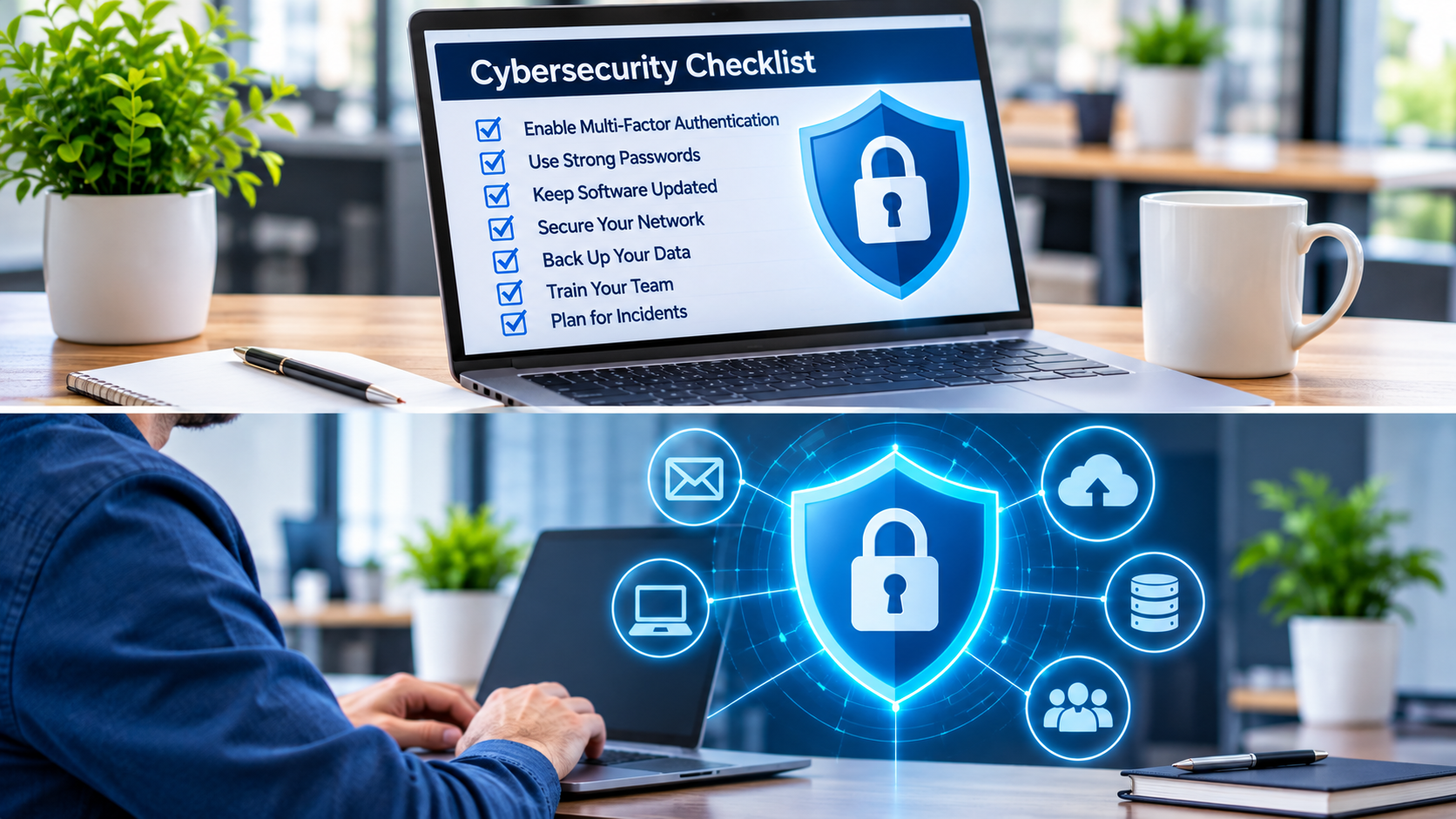
Technology alone cannot eliminate cybersecurity risks.
Employees should understand how to recognize suspicious messages, report unusual activity, and protect business information.
Training should cover:
- Phishing and fraudulent emails.
- Suspicious links and attachments.
- Password and MFA security.
- Business email compromise.
- Safe use of cloud applications.
- Reporting lost devices or suspicious account activity.
Short, recurring training sessions can help reinforce good habits.
Encourage employees to report possible mistakes quickly without fear of embarrassment.
Action item: Establish a simple reporting process and provide regular cybersecurity awareness training.
10. Evaluate Third-Party Vendor Security
Many small businesses depend on external providers for payroll, payment processing, cloud storage, accounting, and IT support.
These relationships can introduce security risks when vendors have access to business systems or sensitive information.
Ask vendors:
- What information can your organization access?
- How is our business data protected?
- Do you support multi-factor authentication?
- How are security incidents reported?
- What happens to our data when the contract ends?
- How is access removed when services are discontinued?
Document vendor access and review it periodically.
Action item: Maintain a list of critical vendors, their access permissions, and security contacts.
11. Create a Cybersecurity Incident Response Plan
A cybersecurity incident response plan explains what employees should do when suspicious activity or a confirmed security incident occurs.
A basic plan should identify:
- Who employees should contact immediately.
- How affected systems should be isolated safely.
- Who is responsible for investigating incidents.
- How important evidence will be preserved.
- Which backups and recovery systems are available.
- Who communicates with customers, insurers, and other affected parties.
The plan should also account for applicable contractual and legal notification obligations.
If ransomware or another serious incident occurs, seek qualified incident response assistance promptly. Avoid wiping affected systems or destroying evidence before receiving appropriate guidance.
Action item: Create a written incident response plan, store an accessible offline copy, and practice it periodically.
Small Business Cybersecurity Checklist: 30-Day Action Plan
Small businesses do not need to complete every security improvement immediately.
However, high-impact protections should be prioritized rather than postponed.
Timeline | Priority actions | Expected outcome |
Days 1–7 | Enable MFA, secure critical passwords, remove unused accounts, confirm backups exist | Reduce immediate account and data risks |
Days 8–14 | Inventory devices, review software updates, secure Wi-Fi and remote access | Improve visibility and network protection |
Days 15–21 | Review email protections, test backup recovery, assess employee and vendor permissions | Strengthen detection and recovery readiness |
Days 22–30 | Train employees, document incident procedures, assign ongoing responsibilities | Establish repeatable security practices |
Ongoing | Monitor updates, review access, test backups, refresh training | Maintain and improve cybersecurity |
Important: This timeline is a planning example. Critical vulnerabilities, active incidents, or regulatory obligations may require faster action.
What Cybersecurity Standards Should Small Businesses Follow?
The National Institute of Standards and Technology provides a recognized framework for organizing cybersecurity risk management.
The NIST Cybersecurity Framework 2.0 Small Business Quick-Start Guide is designed to help smaller organizations begin developing a practical cybersecurity strategy.
Its six core functions are:
- Govern: Establish cybersecurity responsibilities and risk-management direction.
- Identify: Understand important assets, systems, and risks.
- Protect: Implement safeguards to reduce cybersecurity exposure.
- Detect: Recognize suspicious activity and potential incidents.
- Respond: Take appropriate action when incidents occur.
- Recover: Restore affected operations and improve resilience.
Small businesses can use these functions to organize their security improvement efforts without adopting an unnecessarily complex program.
For additional practical guidance, the CISA Secure Our World initiative provides resources covering password security, MFA, phishing awareness, and software updates.
These resources support cybersecurity planning but do not automatically establish compliance with industry-specific regulations.
Why Cybersecurity Matters for Marquette, MI Small Businesses
Businesses in Marquette County and Michigan’s Upper Peninsula rely on technology for communication, payments, customer records, scheduling, and daily operations.
Retailers, healthcare providers, manufacturers, hospitality businesses, and professional offices may face different risks, but all benefit from maintaining secure and reliable systems.
For many smaller organizations, the challenge is not understanding that cybersecurity matters. It is finding enough time and technical resources to maintain security consistently.
Benefits of Working With a Local IT Provider
Local IT support may provide:
- On-site troubleshooting when physical access is required.
- Network and device maintenance.
- Assistance with backups and system updates.
- Coordination between business technology systems.
- Ongoing support as business needs change.
Superior Eagle provides IT and Managed Services for Marquette County and Upper Peninsula businesses, including technology support and related infrastructure services.
Businesses using connected cameras and access control systems may also benefit from reviewing Access Control and Security Camera Solutions as part of their broader network security planning.
The right provider should explain which security services are included, which require additional specialists, and how responsibilities are divided.
Frequently Asked Questions About Small Business Cybersecurity
1. What are the most important cybersecurity steps for a small business?
The most important starting steps are enabling MFA, using strong unique passwords, installing security updates, maintaining tested backups, and training employees to recognize phishing. Businesses should also maintain an inventory of systems, restrict unnecessary access, and create an incident response plan.
2. How often should a small business review its cybersecurity checklist?
Cybersecurity controls should be reviewed regularly and whenever important systems or staffing arrangements change. A quarterly review is a practical starting point for access permissions, backups, and device inventories. Critical software updates and suspicious activity require more immediate attention.
3. Do small businesses in Marquette, MI need cybersecurity protection?
Yes. Businesses in Marquette face many of the same cybersecurity risks as organizations elsewhere, including phishing, ransomware, stolen credentials, and data loss. The appropriate level of protection depends on the company’s technology, sensitive information, contractual obligations, and operational risks.
4. What should a small business do first after a suspected cyberattack?
Contact qualified IT or incident response support, follow the incident response plan, and contain affected systems when it is safe to do so. Preserve evidence, secure potentially compromised accounts using trusted devices, and assess whether insurers, customers, or authorities must be notified. Avoid wiping systems before appropriate investigation.
5. Can managed IT services help improve small business cybersecurity?
Managed IT services can support cybersecurity by maintaining devices, applying updates, managing backups, and assisting with network administration. However, managed IT does not automatically include comprehensive threat monitoring, incident response, or formal security assessments. Businesses should confirm the specific protections included in their service agreement.
Strengthen Your Small Business Cybersecurity With Superior Eagle
Protecting your business starts with understanding its technology, securing important accounts, maintaining reliable backups, and preparing employees for potential threats.
This 11-step small business cybersecurity checklist provides a practical foundation, but ongoing maintenance is necessary as your business grows.
Superior Eagle supports businesses in Marquette, MI, and throughout Michigan’s Upper Peninsula with IT services and technology infrastructure solutions.
Whether you need help maintaining business systems, improving network reliability, or understanding available technology support options, the next step is a conversation about your needs.
Ready to improve your business technology and security practices?
Contact Superior Eagle to discuss your IT infrastructure, network concerns, and available support solutions.